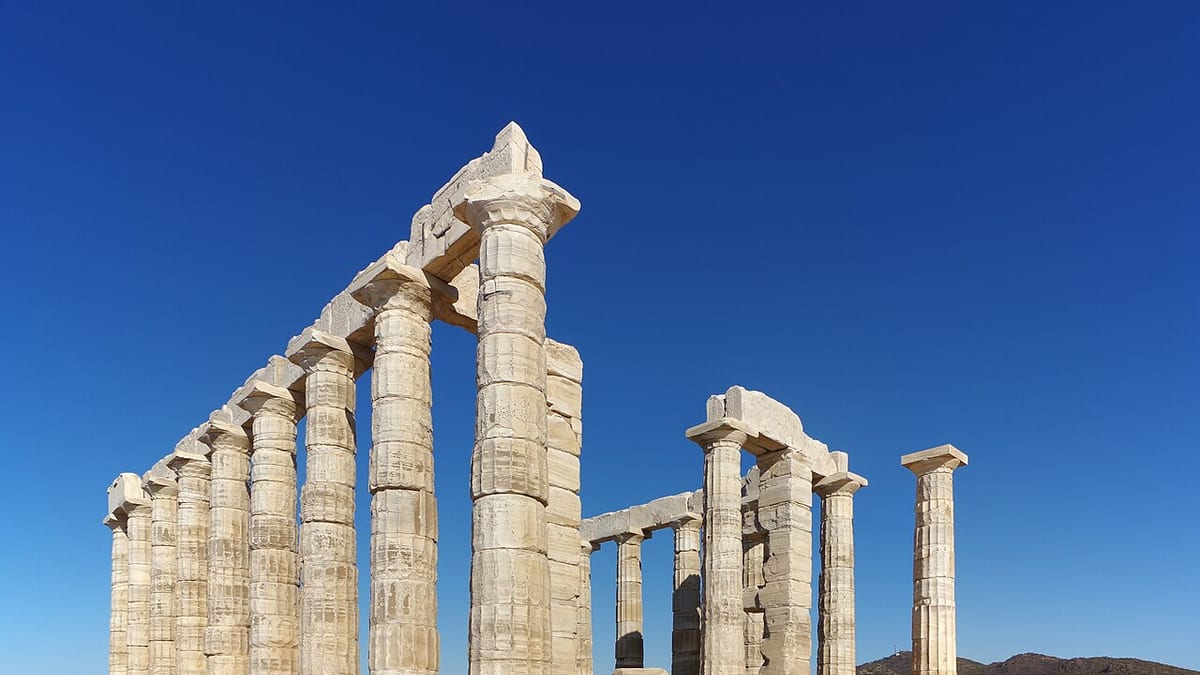
A Cape Sounion sunset is worth planning when you want the Temple of Poseidon and its coastal setting together, not merely a photograph taken at the last possible moment. Arrive while there is time to explore, then stay for the changing light. The crucial restriction is that final admission is twenty minutes before sunset, when the site closes. [1]
Arrive for the temple, not just the final minutes
Hellenic Heritage lists opening from 9:30am until sunset in both its summer and winter schedules. The final-entry cutoff is twenty minutes before closing. That does not mean twenty minutes is the recommended visit length; it is simply the latest permitted admission under the published rules. [1]
My planning recommendation is to aim to be at the site well before the final hour begins, with additional margin for the journey and entry. This is not an observed queue average or an official requirement. It gives you time to look at the temple, understand the layout and choose a viewing position without spending the whole visit watching the clock.
Do not use a sunset time copied from a summer itinerary for a winter outing. Find the time for your actual date, then work backwards through entry, arrival and transport. A booking advertised as a sunset tour should still state when you reach the site and when the vehicle leaves afterward.
The distinction between sunset and darkness matters operationally too. A site closing at sunset is not promising an extended after-dark session among the ruins. Follow staff instructions and avoid planning photographs that depend on remaining after visitors are asked to leave.
What you are going to see
The Temple of Poseidon occupies the cape above the sea. Visit Greece presents Sounion as a coastal archaeological destination, while Hellenic Heritage places the surviving Doric temple in the mid-fifth century BC. Its importance is not limited to the sunset backdrop: this was a strategic position associated with control of maritime approaches. [1][2]
Give the architecture some attention before the light becomes the main event. Walk the permitted route, look at how the columns sit against the coastline and distinguish the temple itself from the wider sanctuary setting. You do not need a specialist lecture to appreciate why this position mattered.
A guided outing is useful when you want historical interpretation as well as transport. An independent visit is perfectly reasonable when your priority is time with the landscape and you are willing to read the official account beforehand. Neither approach guarantees better weather or an unobstructed photograph.
For photographers, decide whether the subject is the temple, the sea or the people in your group. Those choices may require different positions and different moments. Constantly changing location in search of every possible composition can make the most attractive part of the evening feel hurried.
Tickets: separate admission from the excursion price
The official listing gives standard admission as €20 and reduced admission as €10, with eligibility conditions applying to reductions. It also identifies specific free-entry dates. These are site charges and arrangements; a coach, minibus or private-driver excursion may include them or may sell transport only. [1]
For two adults paying the full site rate, admission totals €40. Add that to the transport quotation when comparing an excursion whose ticket is excluded. A slightly more expensive advertised tour can be competitive once inclusions are made like-for-like.
Do not choose a reduced ticket merely because you are a student or older traveler without reading the actual eligibility rules. Carry the documentation required for the category you book. Similarly, a free-entry day removes the admission charge, not the need to arrange transport or respect the opening schedule.
Use the official ticket link reached from Hellenic Heritage when buying independently. A reseller can provide a legitimate bundled service, but its price should not be mistaken for the archaeological site's standard admission. Identify what the additional charge purchases before paying it.
The return journey is the real sunset problem
KTEL Attikis identifies a coastal Athens–Sounion route serving central stops and the southern suburbs. The existence of that route does not, by itself, prove that a bus will depart after sunset on your chosen date. A morning timetable and an evening return are two different pieces of information. [3]
For a sunset visit, confirm the last usable return before leaving Athens. Establish the exact stop, whether you need a ticket in advance and what happens if the site visit runs later than planned. Do not rely on a photograph of a timetable from another season.
A prearranged driver or organized excursion can solve this problem if the return is explicitly included. Agree on the pickup location and departure time, and ask whether the driver waits on site or returns later. With a rental car, ensure the person driving is comfortable with the route after dark; a pleasant coastal afternoon can end with a different kind of driving experience.
Independent bus travel may be the better choice for a daytime archaeological visit. It becomes a less attractive bargain when the main objective requires staying beyond the last confirmed return. The correct comparison is not "bus versus tour" in the abstract, but "a complete journey that supports my intended visit."
Weather, clothing and realistic expectations
Sunset is an astronomical event; a colourful, unobscured view is not guaranteed. Cloud, haze and changing weather can alter the appearance of the evening. Decide before departure whether you would still enjoy the temple and coast without the photograph you have imagined.
For travelers on a longer Athens stay, keep this excursion movable until the forecast becomes useful. For those with one available afternoon, book for the overall place and accept that the light is a bonus. An outing chosen solely for one exact image is more vulnerable to disappointment.
Bring a layer appropriate to the forecast and shoes suitable for a walking visit. Keep bags manageable so that moving through the site is easy, and avoid placing tripods, coats or equipment where they obstruct others. Follow barriers and visitor instructions even when another angle appears more photogenic.
Accessibility should be discussed with the site or tour operator in specific terms. Ask about the route from the vehicle to the viewing area, gradients, surfaces and any assistance required. A vehicle bringing you to the entrance does not automatically settle the rest of the visit.
Build an afternoon that does not depend on luck
A sensible sequence is to leave Athens with a clear transport arrangement, arrive with time for the archaeological visit, watch the light change and return by the method already agreed. Add a meal or coastal stop only if it does not consume the margin needed for your main purpose.
Families may prefer an earlier visit followed by an easy meal rather than insisting that children remain patient through a late photographic session. Travelers who want quiet historical observation may also prefer another time of day. Sunset is a compelling option, not the only valid way to experience Sounion.
Avoid combining the excursion with a tightly timed airport departure. It introduces too many dependencies: traffic, the duration of the visit, the return journey and airport formalities. Save Sounion for a day when the evening can unfold without a flight deadline dominating it.
The successful version is straightforward: know the entry cutoff, arrive substantially before it, understand what your ticket includes and have a return that works after the light fades. Once those decisions are settled, the cape can be enjoyed as a place rather than treated as a race against the sun.