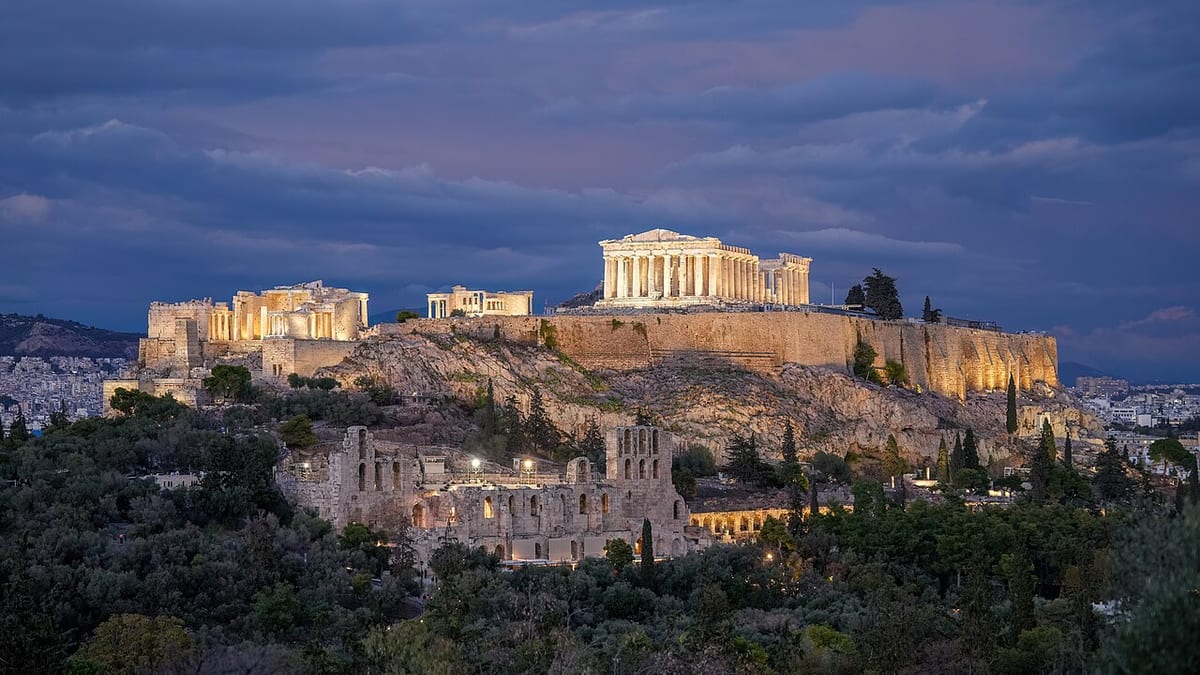
The Acropolis is worth visiting for most first-time travellers interested in Athens, provided they expect an outdoor archaeological site rather than a furnished temple or an indoor museum. The most important decisions are when to climb, how much physical effort the route involves and whether to add the separately ticketed Acropolis Museum. A carefully timed visit is more useful than an overfilled checklist. [1] [2]
What you see on the hill
The Parthenon is the best-known monument, but it is not the entire visit. The heritage operator also identifies the Propylaea, Erechtheion and Temple of Athena Nike within the Acropolis ensemble. Seeing them in relation to one another helps explain why the hill is more than a viewpoint with a famous building. [1]
Allow yourself to look at the layout rather than moving immediately from one photo position to the next. Notice the approach, the change in scale as you enter and the relationship between buildings and the surrounding city. Those observations are available even without specialist knowledge.
A guide can add historical interpretation, but a guide is not compulsory for understanding the basic experience. Choose one when questions and context matter to you, especially on a first encounter with classical architecture. Go independently when you prefer to read at your own pace and control the amount of time spent at each point.
Do not expect to walk through restored domestic interiors or see every original sculpture in place. The museum is the complementary place for objects and closer examination. This distinction is a reason to consider both visits, not a reason to dismiss the hill as "only ruins." [3]
Budget for two different admissions
The official full-price Acropolis ticket is €30, with a €15 reduced category for eligible visitors. The Acropolis Museum separately lists €20 general admission and €10 reduced admission. Eligibility rules and supporting documents matter; neither reduced price should be assumed merely because a visitor is a student or an older adult. [1] [3]
A full-price adult visiting both therefore pays €50 in admission before guiding or transport. Two full-price adults pay €100. These calculated totals help explain why an apparently inexpensive third-party product needs careful reading: it may cover only one of the two attractions.
The museum explicitly states that its ticket is independent of the archaeological-site ticket. Buying a museum entry time does not reserve entry to the hill, and the reverse is also true. Check the exact product name before paying, particularly when a seller uses a photograph of the Parthenon for a museum listing. [2]
When money is limited, choose according to your interest. The hill is stronger for monumental setting and the relationship with the city. The museum is stronger for close viewing of objects and a less exposed environment. A visitor who cannot comfortably manage the archaeological route should not feel that choosing the museum makes the trip incomplete.
Book around entry, not an optimistic arrival time
Acropolis entry is allocated by time slot. The official ticketing notice advises arriving before the selected time and describes a limited tolerance around it; the conditions attached to your actual booking should guide the final plan. Do not build a schedule around being admitted whenever you happen to arrive. [4]
Separate three things: reaching the neighbourhood, reaching the correct entrance and passing the entry checks. A café reservation or hotel checkout immediately before the slot can make those small steps unnecessarily stressful. Save the ticket offline and keep the eligibility document with it when a concession applies.
For the ordinary winter schedule, the heritage operator lists 08:00–17:00 opening, with last admission twenty minutes before closing. Late October has a different closing time, so a visit around the seasonal change needs the schedule for the actual date rather than a generic "open until sunset" assumption. [1]
As an editorial planning allowance, leave roughly ninety minutes to two hours for an unhurried archaeological visit, with extra time when using a guide or needing a slower pace. That is not a measured average or a guaranteed minimum. It is a way to avoid placing the next booking so close that the visit becomes a race.
The museum can improve the order of your day
There is no universal rule that the museum must come first. Reading the objects before climbing can make the site easier to interpret. Visiting afterwards can answer questions raised by the buildings. Choose the sequence that also makes sense for weather, energy and the available entry slots.
For example, a traveller with an early archaeological booking could keep the later museum visit flexible enough for lunch in between. Someone whose outdoor slot is later might use the museum as preparation rather than adding another exposed walk beforehand.
The museum's winter Friday opening extends to 22:00, whereas its excavation and other facilities can have separate schedules. That creates an option for spreading the visits rather than forcing them into one continuous block. It does not mean that the Acropolis archaeological site is open equally late. [3]
Avoid treating a café visit as museum admission. The operator distinguishes its exhibition ticket from access arrangements for shops and restaurants. Buy the collection experience you actually intend to have rather than assuming that any booking inside the building includes it. [3]
Mobility and weather can change the recommendation
The archaeological site has an elevator and designated accessibility arrangements, but that is not the same as saying that every visitor can use every path without difficulty. The heritage information describes eligibility and operational limitations; weather can also affect the elevator. Confirm the practical route when step-free access is essential. [1]
Explain the requirement specifically: wheelchair dimensions, ability to walk short sections, need for an accompanying person or difficulty with prolonged standing. A vague question about whether the site is "accessible" can produce an answer that does not address the part of the visit that matters to you.
For everyone, choose footwear that handles uneven surfaces and avoid making the climb the final task after an exhausting day. Carry water and suitable sun or rain protection. When the forecast or an official closure notice changes the plan, the museum and another indoor activity may be a better use of the day than trying to force the original itinerary.
The Acropolis deserves its place in an Athens visit, but it does not need to be approached as an endurance test. Pay for the correct admissions, protect the entry slot, choose interpretation that suits you and give the hill enough attention to understand more than the familiar silhouette.