Zappeion is worth visiting as part of a walk through central Athens, especially when you want architecture, garden paths and a break from paid archaeological sites. It is less suitable as a standalone destination for someone expecting a conventional museum. The building remains an events venue, so admiring its exterior and entering its halls are different propositions. [1] [2]
What makes the stop worthwhile
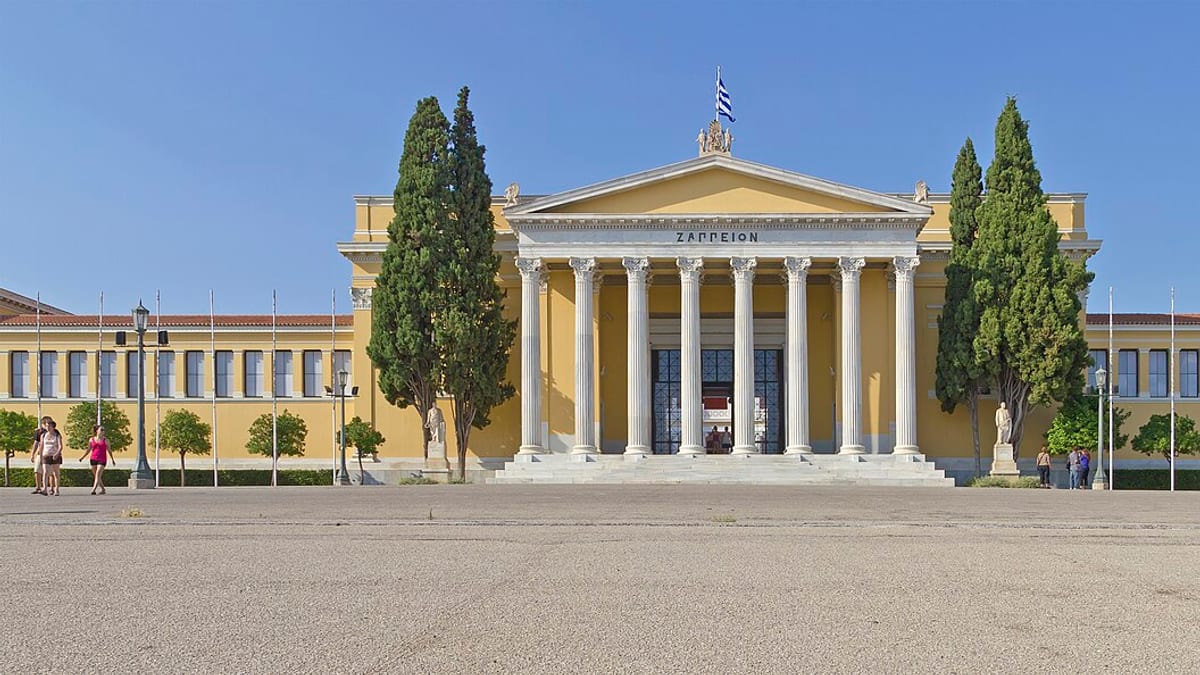
The appeal begins with the building rather than a collection. Its long, symmetrical frontage and ceremonial entrance introduce a different chapter of Athens from the temples on the Acropolis. Zappeion was designed by Theophil Hansen and developed between 1874 and 1888 around the vision of benefactor Evangelis Zappas, whose ambitions included reviving the Olympic spirit and promoting the arts. [1]
That context changes how to look at it. Instead of searching for ancient ruins, consider a nineteenth-century city presenting itself through monumental architecture. The scale, ordered columns and broad approach are part of that story. A few minutes spent reading about the patron and purpose will usually add more than taking another photograph without understanding the building.
The official site also offers a virtual tour. That is a useful way to see the circular central atrium and decide whether an event inside would interest you. It is not evidence that every space shown online is open to casual visitors on the day you arrive. [2]
For an architecture enthusiast, the exterior can justify a deliberate stop. For someone with only a few hours in Athens and a strong interest in antiquity, I would place the Acropolis or an archaeological museum ahead of it. Zappeion works particularly well when you are already walking between nearby central sights.
Do not mistake a working venue for an open museum
Zappeion advertises conference, exhibition and cultural-event facilities. Its official visitor material does not establish a dependable daily public tour through all the interior rooms. An open-looking door therefore should not be treated as an invitation to wander into a congress or private reception. [2]
The practical approach is simple: plan for the gardens and exterior, then treat legitimate interior access as an addition. When a public exhibition or event is advertised, use that organiser's entry instructions, dates and ticket conditions. A fee for an exhibition is not necessarily a general admission charge to the entire building.
Someone travelling specifically to photograph the atrium should contact the venue about access before committing a morning. Professional photography, equipment and organised shoots may involve permissions beyond ordinary sightseeing. Do not assume that permission to attend a public event includes the right to photograph every room or participant.
This distinction also helps families. An exterior visit can be flexible and brief, while an exhibition might have a fixed route, queues or limited space for a pushchair. Choose the actual activity you want rather than booking around the word "Zappeion" alone.
Give the gardens their own time
The Zappeion gardens are not simply a strip of planting in front of the façade. The operator describes a substantial landscape adjoining the National Garden, with paths, planted areas, fountains and sculpture. The first trees were planted in 1857, and the design evolved from formal geometry towards a less rigid garden layout. [3]
It is worth noticing that change of mood. Walk away from the main entrance long enough to see the building from an angle, then choose a path rather than retracing every step. The purpose need not be to identify every tree or monument. A quiet circuit can provide a useful pause between more demanding sightseeing stops.
As a planning allowance, reserve approximately half an hour for the façade and a short garden walk, or closer to an hour when you want photographs and a relaxed stop. Those are suggested allocations, not measured average visit lengths. An exhibition, when available, should be budgeted separately.
Do not turn the open space into an excuse to ignore the weather. On a hot day, move the walk towards the cooler part of your itinerary; in rain, an exterior-only visit loses some of its value. The gardens are not a substitute for a guaranteed indoor activity.
Make it part of a route rather than another transfer
The official garden boundaries include Vasilissis Amalias, Vasilissis Olgas, Irodou Attikou and Vasileos Konstantinou. That places the visit within the central garden-and-stadium area rather than somewhere requiring a separate excursion from Athens. [3]
A useful sequence is to approach through the central gardens, look at Zappeion, then decide whether to continue towards the stadium area or return towards the historic centre. Choose one onward direction. Walking back and forth merely to tick off map pins makes a compact afternoon feel unnecessarily tiring.
Keep each attraction's access separate. Being able to walk around Zappeion does not grant entry to another monument, and a ticket to a nearby attraction does not provide access to its event halls. Reserve your paid sightseeing first, then use the gardens as the flexible element between bookings.
For a visitor who dislikes crowded itineraries, this is the strongest reason to include Zappeion. It offers something visually distinctive without needing to become a second major commitment. Stop when it fits naturally, rather than allowing a minor detour to displace the museum or meal you most wanted.
Mobility, photographs and small practical choices
Do not judge the whole visit's accessibility from a photograph of the main steps. The useful question is which garden approach, entrance and event space you intend to use. Someone needing step-free access to an interior programme should ask the organiser about that specific route, seating and accessible toilets.
For an exterior visit, carry a map showing the approach you have chosen. A long garden loop may be pleasant for one person and an avoidable extra distance for another. Set a turnaround point before fatigue becomes the deciding factor.
For photographs, leave room in the frame for the approach and gardens rather than concentrating only on the columns. Avoid blocking entrances, particularly when an event is loading equipment or admitting delegates. The building's ongoing use is part of its character, not an inconvenience that visitors are entitled to interrupt.
Zappeion is therefore an easy recommendation for a thoughtful central walk, but a conditional one for an interior visit. Go for the architecture and landscape you can reasonably plan around. Choose a confirmed public event when the halls themselves are the priority, and let the building occupy the right amount of your Athens itinerary rather than forcing it to become a full museum day.